
News
Sanusi Calls for Clearer Separation of Religion and Politics

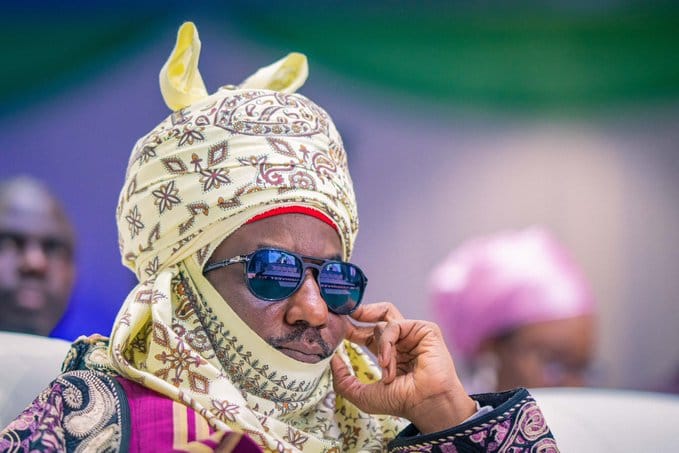
The Emir of Kano, Muhammadu Sanusi II, has called for a clearer separation between religion and politics, urging religious leaders to focus on their spiritual responsibilities while politicians concentrate on governance and development.
Sanusi made the remarks on Thursday in Abuja at the public presentation of Military Transformational Leadership in Action: The Buratai Era.
The Emir expressed concern over the growing overlap between religious and political roles in Nigeria, saying the development had increasingly blurred the distinction between clerics and politicians.
“It is not the responsibility of politicians to give us religion. They are there to give us education, to give us health care, and to give us an economy,” Sanusi said.
He added: “Allow the religion to be in the hands of those who are religious leaders. It is also not the duty of religious leaders to get into politics.”
According to him, the situation had become particularly pronounced in Nigeria.
“Right now, there’s no distinction between imams and bishops and senators. Everybody is a politician,” he said.
Sanusi Warns Against Politicisation of Religion, Ethnicity
Sanusi also linked the politicisation of religion and ethnicity to Nigeria’s security challenges, arguing that the country’s crisis predates the emergence of banditry, Boko Haram insurgency and terrorism.
He said the problem was rooted partly in divisive rhetoric that increasingly encouraged Nigerians to identify themselves along ethnic, regional and religious lines rather than primarily as Nigerians.
“It started with the violence in words that we saw in newspapers and that we heard from politicians, where we started categorising ourselves not as Nigerians but as northerners and southerners, Muslims and Christians, Yoruba and Igbo and Hausa,” he said.
The Emir warned that continued politicisation of ethnicity and religion could create conditions for further violence.
“Until we begin to walk back from the politicisation of ethnicity and the politicisation of religion and free our politics from these base considerations, we are only laying the foundation for a new round of violence,” he said.
Sanusi urged Nigerians to strengthen their sense of national identity and place greater emphasis on development.
“We have to go back to seeing ourselves as Nigerians, as people committed to this country, and focus on what is important, which is the development of our people,” he said.
Sanusi Urges Protection of Key Institutions
The Emir also stressed the importance of strong leadership and institutions in ensuring effective governance.
“The truth is we need both. A strong leader cannot perform if the institution itself is not strong. And no matter how strong an institution is, if you place a weak leader on top of it, he destroys it,” he said.
He said the strength of an institution should be measured by its adherence to its legal and professional responsibilities rather than its coercive powers.
Using the judiciary as an example, Sanusi said judges must be able to perform their duties impartially without political influence or financial inducements.
He therefore called for the military, police, Central Bank of Nigeria, judiciary and press to remain insulated from partisan politics.
“We need to stop politicising institutions: the military, the police, the central bank, the judiciary, and the press. These are institutions that are there to hold political society in check,” he said.
Sanusi warned that such institutions would struggle to effectively provide checks and balances if they became absorbed in the interests of political actors.
“The moment we all get absorbed into the projects of politicians, we cannot hold political society in check,” he said.
He further urged institutions to adopt a long-term perspective beyond the four-year electoral cycle that often shapes the decisions of elected officials.
“The army cannot think in four-year cycles. The police cannot think in four-year cycles. The central bank cannot think in four-year cycles,” he said.
“We have to think 20 years, 30 years, 50 years, whereas elected officers are thinking in four-year cycles; they’re two different mindsets.”