
Opinion
[Op_Ed] : Hon. Moshood Bakare and Recovery of Representative Democracy – By Engr. Ridwan Elemosho

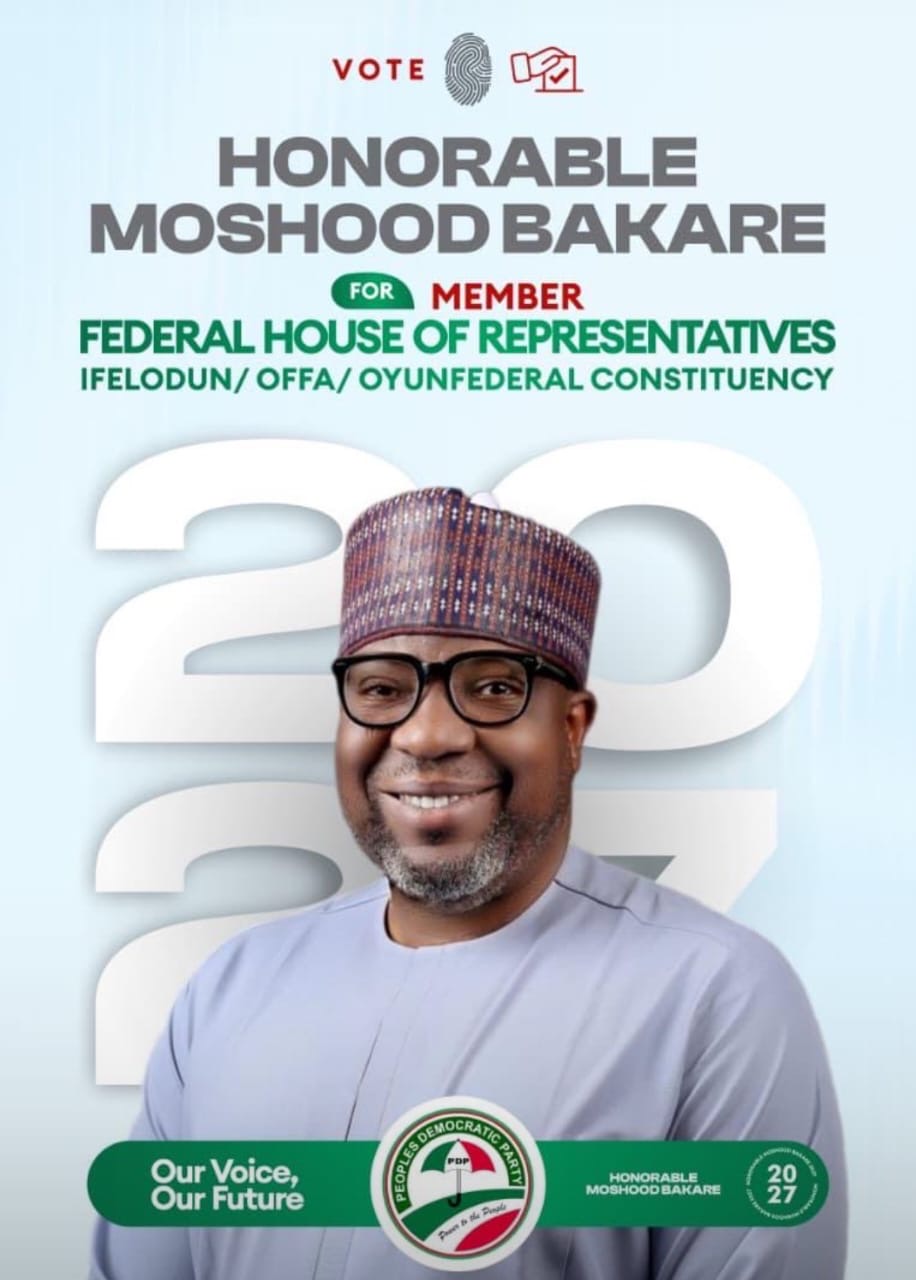
The quality of a democracy is reflected in the quality of representation it produces. Electoral competition has conditioned voters to perceive representation as a question of political prominence. Who commands visible media presence, who distributes resources most generously, who throws the largest homecoming celebration. These have become the metrics by which representation is judged. They are also the metrics by which it has failed. A legislator who spends four years building personal visibility but produces no meaningful oversight of government spending has not represented his constituency he has occupied it. Nigeria possesses legislatures populated by politicians but starved of legislators. The difference is foundational: politicians seek office; legislators use office to pursue coherent visions of public value. Ifelodun, Offa and Oyun must demand more. This is precisely the standard that distinguishes Hon. Moshood Bakare from ordinary candidates.
Hon. Bakare’s professional trajectory is evidence of genuine preparation for legislative responsibility. Preparation that most candidates lack. His experience in banking and finance provided direct education in how capital functions, how financial institutions operate under constraint, how economic systems generate the resources upon which constituencies depend. His years in executive public service exposed him to government’s actual machinery: how policy translates into implementation, where institutional coordination fails, how to align bureaucratic incentive structures with legislative intent. His two terms in the Kwara State House of Assembly placed him at the centre of legislative responsibility, with committee assignments in finance, appropriation and public accounts. The structural backbone of effective governance. Hon. Bakare has operated across the three institutional contexts that determine whether a legislator can actually deliver: the economic system generating constituent resources, the government apparatus allocating them, and the legislative system through which budgetary control is exercised. This is not political experience. This is institutional preparation.
Hon. Bakare understands what constituent development actually requires. Legislative clarity: the creation of frameworks within which enterprise, agricultural productivity, skills development and capital access can operate. Hon. Bakare’s background in finance and government positions him to craft legislation enabling communities to generate their own development rather than waiting for political patronage. Institutional alignment: development fails when government agencies, private sector and communities operate at cross-purposes. Hon. Bakare’s experience in executive coordination means he will reduce fragmentation and align incentive structures toward common objectives. Community engagement as governing principle: representation must be continuous and dialogical, rooted in sustained consultation. Hon. Bakare’s institutional background has trained him to see the constituency not as an electoral bloc but as a complex community with specific sectoral needs. For Ifelodun, Offa and Oyun, with substantial agricultural base, emerging commercial activity and significant youth population, Hon. Bakare’s framework becomes immediately actionable. Healthcare infrastructure, youth development, agricultural modernisation and local economic development require sustained legislative attention and institutional sophistication. Hon. Bakare brings both.
The 2027 election is a choice between two visions of representation. One promises visibility: periodic appearances, campaign spectacle, emotional appeals. The other promises competence: sustained institutional engagement, rigorous budgetary oversight, meaningful development outcomes. Will Ifelodun, Offa and Oyun accept the politics of visibility or demand the governance of competence? Hon. Moshood Bakare is the candidate who has demonstrated across his entire career that he understands representation as a continuing responsibility rather than a position to be occupied. He respects the intelligence of constituents sufficiently to engage substantively on development strategy, not merely on emotional rhetoric. He approaches public office as a responsibility requiring institutional competence, not as a privilege to be enjoyed. That is the choice before this constituency. That is why Hon. Bakare’s candidacy matters.
MOSH2027 | ÌRÒRÙN DÉ!
Our Voice. Our Future.