
News
Makinde Unveils Presidential Agenda, Promises Economic Reforms, Improved Living Standards

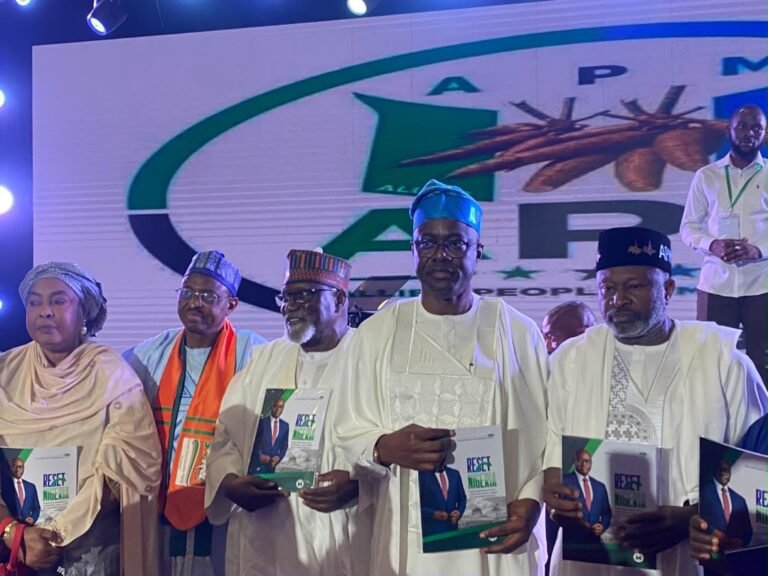
Oyo State Governor and presidential candidate of the Allied Peoples’ Movement (APM), Seyi Makinde, has unveiled his presidential manifesto, outlining plans to address Nigeria’s economic, political, social and institutional challenges.
Makinde unveiled the manifesto on Wednesday in Abuja, where he criticised the country’s leadership, saying Nigeria was blessed with abundant natural and human resources but lacked the ideas needed to harness its potential.
“Nigeria has the resources and the capacity to achieve greatness. Nigeria is rich in natural resources and human resources, but our leaders are poor in ideas,” he said.
The governor explained that the manifesto was developed through extensive consultations with Nigerians across the six geopolitical zones, including town hall meetings designed to understand citizens’ expectations and aspirations.
He said the central objective of his proposed administration would be to make life easier for Nigerians, stressing that economic reforms must translate into affordable food, job creation, improved incomes and a lower cost of living.
Makinde identified weak public institutions, rising poverty and the disconnect between macroeconomic reforms and citizens’ welfare as some of the major challenges informing his presidential ambition.
He also emphasised the need for greater accountability in governance, arguing that political promises must be backed by clear responsibilities, implementation plans and measurable outcomes.
On economic development, the APM presidential candidate promised to reduce the structural cost of living by lowering production expenses and improving the business environment.
He identified high electricity and energy costs as major obstacles to industrial growth, noting that many Nigerian businesses struggled to compete because of their dependence on diesel-powered generators.
He further expressed concern over the relocation of Nigerian businesses abroad, attributing the development to the unfavourable operating environment.
On petroleum pricing, Makinde questioned why Nigerians should continue to bear the burden of rising international crude oil prices without corresponding benefits.
He also criticised the Federal Government over persistent electricity challenges, insisting that Nigerians should hold the administration accountable for its promises to improve power supply.
On governance and democratic reforms, Makinde proposed a transitional government of national unity that would bring together representatives of different interests to discuss the country’s political and constitutional future.
He also pledged to establish measurable performance targets within his first 100 days in office, with his administration’s achievements open to public scrutiny.
Speaking at the event, APM vice-presidential candidate, Lawal Daura, called for inclusive governance, stressing that Nigeria’s democracy required peace, security, stability, prosperity and respect for democratic rights.
Daura warned against suppressing opposition parties, describing a strong opposition as essential to strengthening democratic governance.
He also advocated a national conference involving government representatives, political parties and other stakeholders to deliberate on the country’s challenges and agree on a common direction.
Meanwhile, the National Chairman of the Social Democratic Party (SDP), Sadiq Gombe, who attended the event, described Makinde as a “shining light of the opposition”.
Gombe also commended Bauchi State Governor and APM national leader, Bala Mohammed, for his contributions to sustaining democracy and strengthening opposition politics.
Similarly, APM National Chairman, Yusuf Dantalle, urged Nigerians to resist attempts to use state institutions to undermine democracy.
He said the manifesto unveiling was about Nigeria’s future rather than the interests of any particular political party, adding that political platforms should serve as vehicles for national development.
Dantalle also expressed concern over the country’s security challenges, particularly the growing threat of kidnapping, noting that Nigerians could no longer go about their daily activities without fear, including within the Federal Capital Territory.